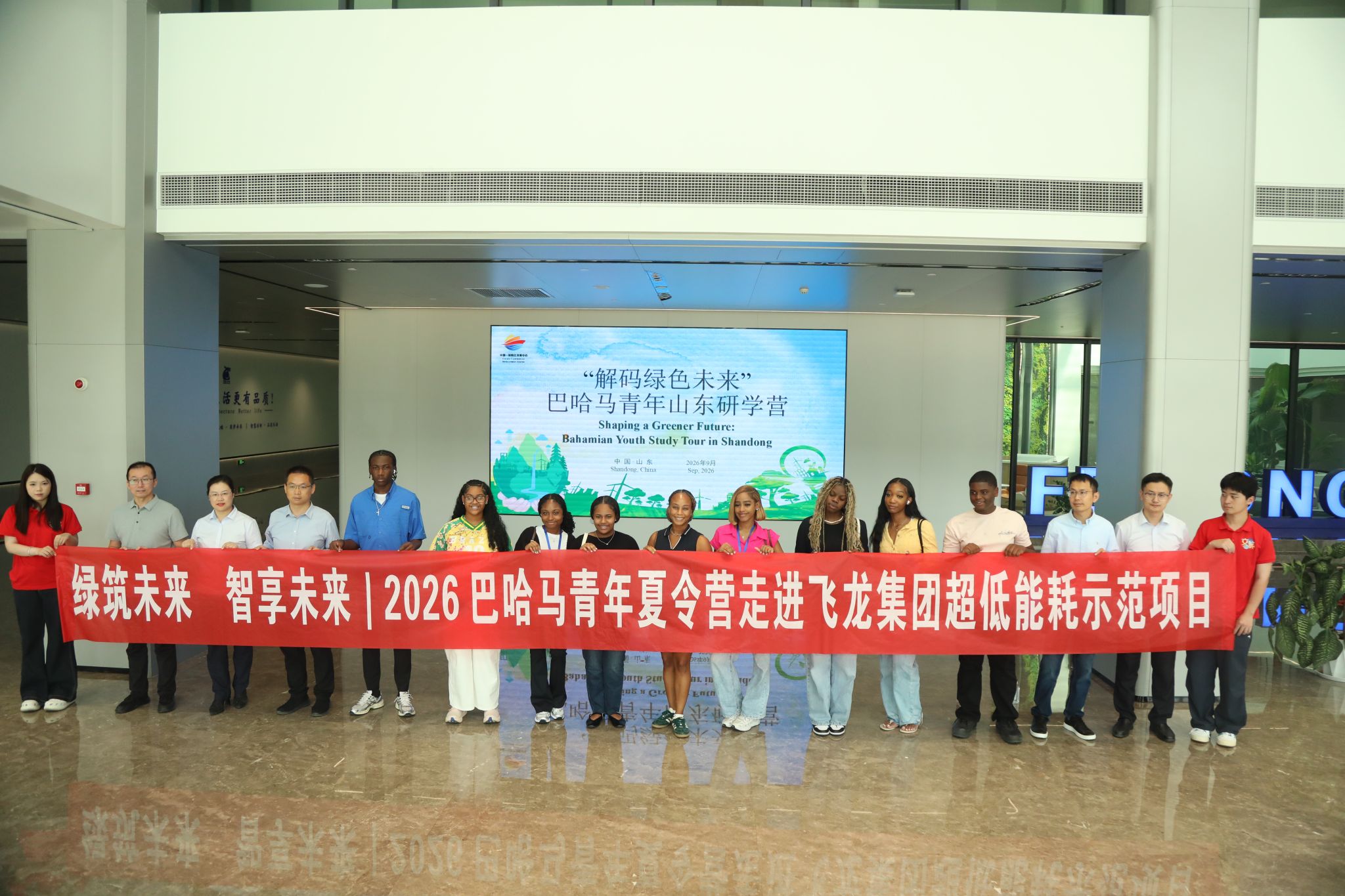
From September 10 to 12, the "Decoding a Green Future" Bahamas Youth Shandong Study Camp successfully concluded at the university. The camp was hosted by the Foreign Affairs Office of the Shandong Provincial People's Government and the Shandong People's Association for Friendship with Foreign Countries, and organized by Shandong Business Vocational College. It attracted teachers and students from the Bahamas International Business, Entrepreneurship and Technology College. The three-day study camp centered on environmental culture learning and cross-cultural exchange, building an important bridge for friendly exchanges between Chinese and Bahamian youth.
Relying on the university's high-quality educational resources, the camp was led by the School of Culture and Tourism and jointly carried out by multiple schools and departments, including the School of Grain, Oil and Food, the School of Architectural Engineering, the School of Art and Design, and the School of Accounting and Finance. Combining the characteristics of vocational education, the university innovatively adopted an immersive teaching model of "cultural experience + skills practice + enterprise research," carefully designing diverse distinctive courses and practical activities focused on green technology development and the dissemination of fine traditional Chinese culture, precisely meeting the learning needs of the Bahamian trainees and showcasing China's low-carbon development achievements and the charm of traditional culture in an all-round way.
The camp's curriculum system was rich and well-developed, covering core modules such as ice-breaking exchanges, intangible cultural heritage experiences, green technology practice, ecological exploration, and urban cultural visits. An experienced internationalized teaching team from the university delivered and organized the entire program, balancing knowledge, hands-on practice, and cultural content. At the beginning of the event, the university held an ice-breaking activity themed "First Encounter in Yantai · Youth Walking Together," incorporating traditional Chinese hairpin flower culture elements, quickly bringing Chinese and Bahamian youth closer and creating a harmonious and friendly exchange atmosphere. In the intangible cultural heritage experience class, teachers led the trainees in immersive experiences of traditional skills such as calligraphy and paper-cutting, allowing the foreign youth to intuitively feel the unique heritage of traditional Chinese culture.
In the green technology practice segment, a series of distinctive courses allowed the trainees to deeply appreciate China's green development strength. The School of Grain, Oil and Food offered a course on polymer protein food production, integrating green food R&D technology and healthy eating concepts into hands-on teaching and explaining the green innovation development path of China's food industry. The trainees visited the "Geng Hai No. 1" marine ranch platform on site, gaining an in-depth understanding of modern marine ecological aquaculture models and China's practice of sustainable marine resource utilization. At the same time, they visited the Feilong Group Innovation R&D Center and ultra-low-energy building demonstration projects, closely observing cutting-edge achievements in green buildings and low-carbon city construction and truly experiencing the vivid practice of China's "dual carbon" development. In addition, the trainees visited local Yantai enterprises and cultural landmarks such as Chaoyang Street, gaining an in-depth understanding of the regional green industry development trends and the city's cultural character.
On the morning of September 12, the camp's closing ceremony was held in Report Hall A106 of Zhongyu Building at the university. Precious Fortune Thompson, President of the Bahamas International Business, Entrepreneurship and Technology College; Tang Tingting, Deputy Director of the Department of American and Oceanian Affairs of the Foreign Affairs Office of the Shandong Provincial People's Government; Wan Hong, Deputy Director of the Foreign Affairs Office of the Yantai Municipal People's Government; and Yu Xingxiang, Member of the Party Committee and Vice President of the university, attended the ceremony. All camp trainees and representatives of teachers and students participated in the event, which was presided over by Qiao Lijun, Dean of the School of Culture and Tourism.
In her speech, Yu Xingxiang congratulated the camp on its successful conclusion and expressed gratitude for the guidance and support of supervisory departments at all levels and the active participation of Bahamian teachers and students. She pointed out that the camp integrated green technology and traditional culture and was an important practice of the university in deepening the opening-up of vocational education and advancing international exchange and cooperation. She encouraged Chinese and Bahamian youth to learn from each other, deepen friendship, and strive to be young ambassadors of cultural exchange between the two countries. Precious Fortune Thompson highly recognized the careful preparation and warm services of the study camp, saying that the trainees truly felt China's green development vitality and cultural heritage and that she looked forward to the two colleges continuing to deepen cooperation and expand exchange areas. Representatives of teachers and students and the Bahamian trainee representative spoke one after another, sharing their study camp gains and sincere friendship. At the end of the ceremony, attending leaders issued completion certificates to the trainees and took a group photo.
The successful holding of this study camp not only effectively disseminated China's green development philosophy and fine traditional Chinese culture and fully demonstrated the university's educational strength in fields such as green buildings, food science and technology, and cultural tourism integration, but also laid a solid foundation for environmental talent exchanges, technology sharing, and school-enterprise cooperation between China and the Bahamas. Next, Shandong Business Vocational College will continue to refine distinctive courses related to foreign affairs, regularly carry out international teacher-student exchange activities, deepen internationalized education, cultivate high-quality technical and skilled talents with both an international perspective and professional ability, and continuously broaden international development channels for teachers and students.