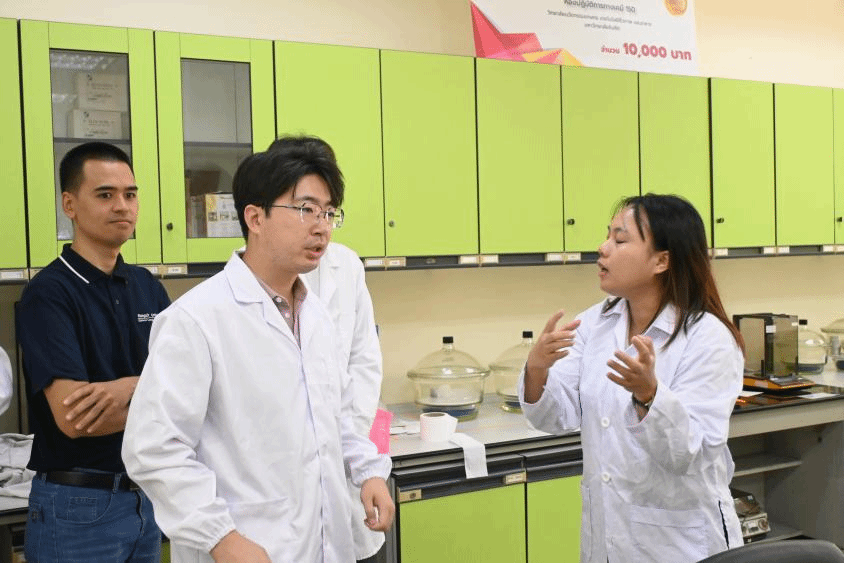
To continuously deepen the scientific and educational collaborative innovation between Chinese and Thai universities in the fields of modern agriculture and grain, oil, and food, and to further strengthen the construction of transnational research platforms, recently, our school's Grain, Oil and Food College organized a delegation of faculty and students to visit Rangsit University in Thailand. Relying on the Joint International Cooperation Laboratory for Deep Processing of Grain and Oil jointly established by both sides, and targeting core topics such as quality analysis of specialty Southeast Asian grain and oil raw materials, fermentation strain selection, and precision testing of agricultural products, joint scientific research experiments were carried out across three functional laboratories—food physicochemical testing, microbiology, and large-scale instrumentation—to promote project implementation and comprehensively establish a sub-field technical exchange and long-term collaborative research mechanism.
Accompanied by the teaching and research team from Rangsit University's Department of Agricultural and Food Engineering, our faculty and students systematically identified common technical challenges in grain and oil quality stability testing, precise microbial cultivation, and localized adaptation and application of precision instruments under the special high-temperature and high-humidity environmental conditions of Southeast Asia. The two sides jointly held a special scientific research promotion meeting. In light of the differentiated characteristics of the grain and oil industries in China and Thailand, they defined the research tasks for the three laboratories: the Food Physicochemical Testing Laboratory would focus on studying the nutritional components and storage quality changes of specialty raw materials such as tropical rice and cassava; the Microbiology Laboratory would advance the isolation, screening, and culture process optimization of locally dominant fermentation strains; and the Large-Scale Instrumentation Laboratory would be used to complete quantitative analysis of trace components and microstructure characterization of grain and oil samples. These three directions simultaneously launched supporting joint research projects. During the collaborative experimental period, Chinese and Thai faculty and students were mixed into groups and stationed in the three laboratories to carry out parallel control experiments. In the Food Physicochemical Testing Laboratory, our teachers explained on-site the standardized testing procedures for routine indicators such as moisture, acidity, and fat content in grain and oil, and guided students from both sides to complete parallel determinations on multiple batches of local grain and oil samples. In the Microbiology Laboratory, the joint team conducted hands-on research on strain purification, constant-temperature fermentation culture, and precise colony identification, and jointly optimized experimental prevention and control plans to address the industry pain point of strains being prone to contamination in tropical environments. The accompanying students participated in all operational steps, data statistics, and result comparisons throughout the process, sharing our school's mature grain and oil testing research system and standardized experimental protocols. Thai researchers proposed front-line technical needs based on local crop processing practices, and the two sides adjusted experimental parameters on the spot, jointly improving the full-chain testing and research system adapted to Southeast Asian specialty raw materials.
Heads of relevant departments at Rangsit University stated that the international joint laboratory project has established a precisely aligned exchange platform for the grain and oil sub-sectors of both countries. Shandong Business Institute's mature grain and oil testing technology, microbiological experimental protocols, and experience in the operation and maintenance of large-scale instruments have effectively filled the existing research gaps of their institution. In the future, they will continue to conduct targeted joint research based on the three laboratories, develop practical technologies suited to Southeast Asia's grain and oil industry, and help improve the quality and efficiency of the local agricultural product processing industry.
Our school's leading teacher stated that this transnational joint research is an innovative practice of integrating international science and education and promoting complementary advantages in specialized research fields between China and foreign countries. At present, our school has established a complete research and training platform covering physicochemical testing, microbial cultivation, and large-scale precision instrument analysis, possessing full-chain grain and oil testing research capabilities. Through the collaborative functioning of the three specialized divisions of the cross-border joint laboratory, we can not only export China's mature standardized grain and oil testing technology system but also fully absorb the distinctive research experience of Southeast Asian tropical grain and oil, achieving deep mutual learning of bilateral research resources.
This international joint research trip to Thailand is an important milestone in expanding our school's international education layout and building a collaborative innovation platform with foreign countries in specialized fields. In the next steps, the school will continue to rely on friendly inter-university cooperation channels with Thailand, take the construction of the Joint International Cooperation Laboratory for Deep Processing of Grain and Oil as the core measure, and systematically promote cross-border research in specialized fields, joint cultivation of bilateral research talent, and the international dissemination of Chinese grain culture. This will continuously enhance the school's international research influence in the grain, oil and food field, and establish a long-term and stable overseas exchange platform for cultivating compound talents in the grain sector who possess a global perspective and comprehensive research capabilities across multiple laboratories.